




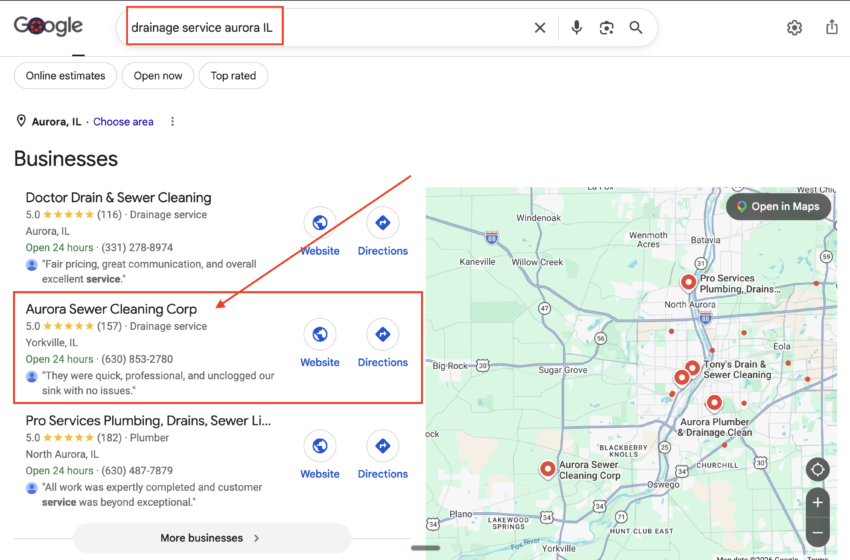
Most businesses can’t rank number one on Google Maps. This one did. Five-star rating, 114 reviews, consistent posting activity, top position for their primary category and city. The GBP is doing everything right. And yet they’re getting 37 visitors a month to their website. That gap is the problem, and it’s entirely fixable.
Why the GBP Is Working
Before getting into what’s broken, it’s worth understanding why this business is ranking so well on Maps. It comes down to three things they’re doing consistently: reviews, recency, and posting.
114 reviews with a five-star rating signals trust. Recent reviews signal that the business is active and customers are still engaged. Consistent GBP posts signal to Google that someone is actually managing this profile. Together, those three behaviors push a profile to the top of local results.
This is the blueprint. Most businesses either have some reviews but no posting activity, or they post but never generate reviews. This one is doing both. That’s rare and it’s working.
The Disconnect: Three Website Problems
The GBP is sending strong signals. The website is not echoing them. Here’s what’s breaking the connection.
Problem 1: Low word count across every page.
Every page on this site is thin. Not a lot of content. Not a lot of words. And that matters because word count determines how many times you can naturally mention your service, your city, and your keywords throughout the page.
Google needs repetition and context to confidently rank a page for a specific search. A page with 150 words doesn’t give it much to work with. A page with 600 to 800 words, written around a specific service in a specific location, gives Google exactly what it needs.
Problem 2: Missing heading structure.
Many pages on this site were either missing H1 tags entirely, missing H2 tags, or relying only on H3 tags with nothing above them. That’s like writing a document with only sub-sub-headings and no actual titles or sections.
Google uses heading tags to understand page hierarchy. H1 tells it what the page is about. H2s break the topic into sections. H3s add further detail. When that structure is missing or inverted, Google has a harder time categorizing the content and ranking it appropriately.
Problem 3: Broken information architecture.
This is the biggest one.
The services listed in the navigation dropdown are not the same as the services listed on the services page. The services page items aren’t clickable. They don’t link to individual pages. And the overall structure of how pages connect to each other is unclear.
Information architecture is the way your website is organized. Which pages live under which parent pages, how they link to each other, and whether a visitor or a search crawler can navigate logically from one section to another. When it’s messy, Google can’t efficiently crawl and index the site. When it’s clean, every page on the site benefits from the authority of every other page.
For this business, the fix is to align the navigation with the services page, make every service a clickable individual page, and nest them properly under a parent services page.
The Opportunity This Business Has
Here’s the thing. Getting 37 visitors a month with a number-one Map Pack ranking is actually a sign of unrealized potential, not failure. The hard part, earning the top local ranking, is done. The GBP is already doing heavy lifting.
If the website content mirrored the GBP, matching categories, services, and location signals, and the page structure was reorganized into a clean hierarchy, this business could multiply that 37-visitor month significantly without any additional off-site work.
The GBP pulled them to the top. The website just needs to meet them there.
For businesses in the Orlando and Central Florida area, if you want to see where your website is losing the traffic your GBP is earning you, we offer free audits. Drop your business name and location and we’ll show you the gap.
DropShadow Agency is a marketing agency based in Orlando, FL helping local businesses get found online.